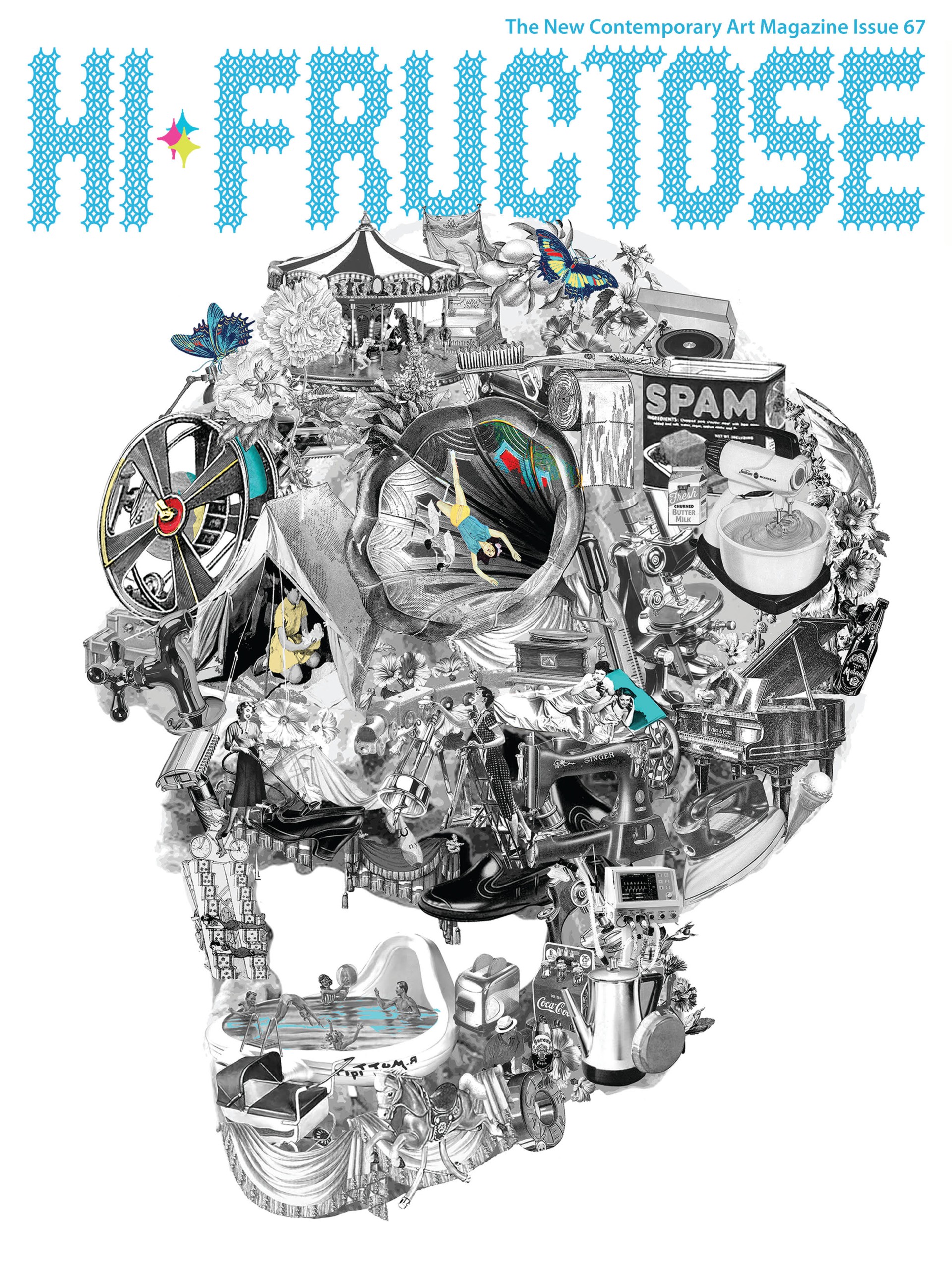
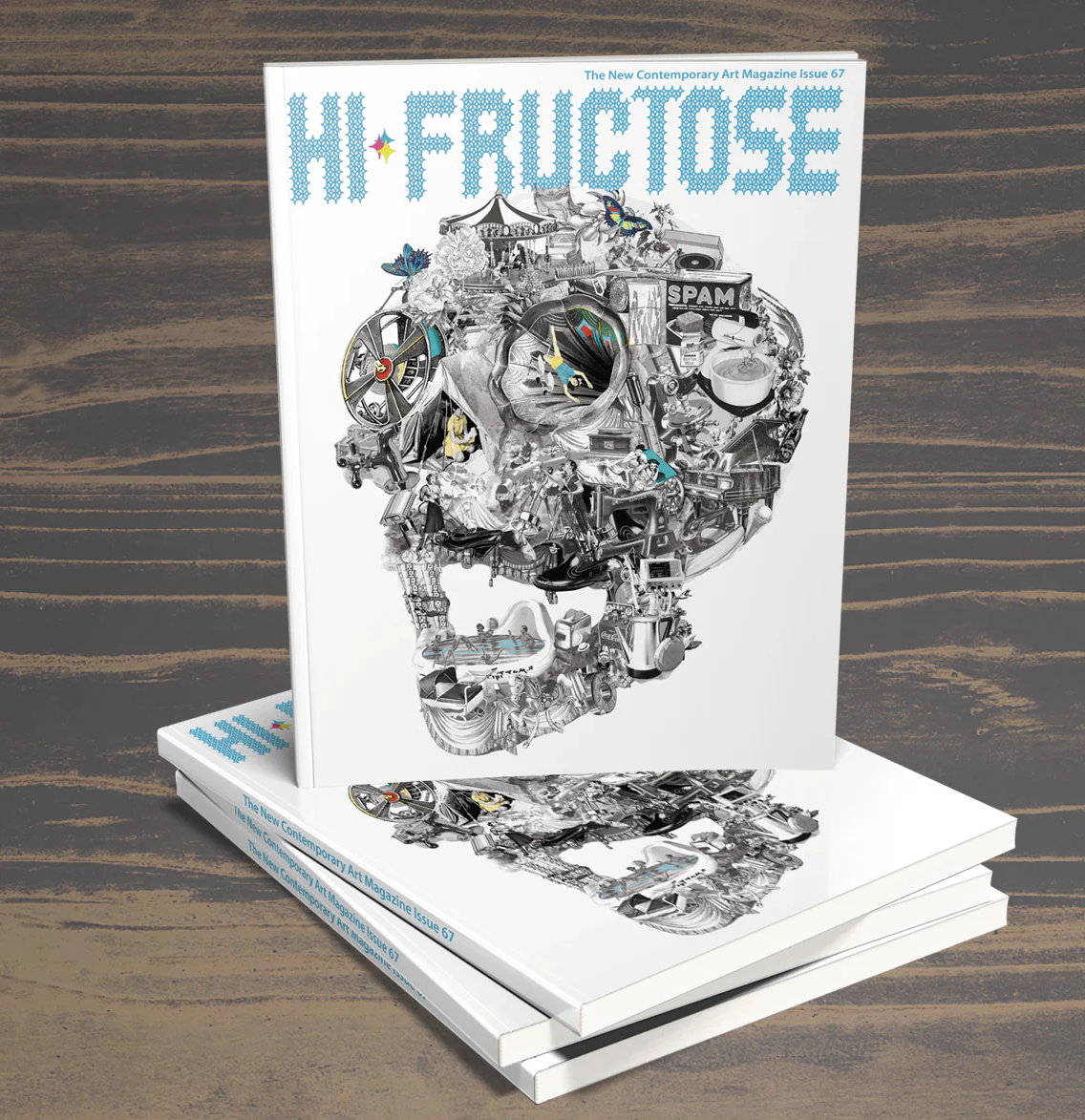
Hi-Fructose — Quarantine Skull on the Cover of Volume 67
10th Apr 2024
Jacky Tsai’s Quarantine Skull appears on the cover of Hi-Fructose Volume 67, accompanied by a multi-page feature and interview exploring the ideas, materials and cultural encounters behind his work.
The conversation moves between traditional Chinese craftsmanship and programmable digital art, returning to the questions that connect these different forms: how an image finds its medium, how cultures speak to one another, and how the skull can become a symbol of life and renewal.
The following highlights are drawn from Tsai’s written responses prepared for the feature in January 2023.
Finding the Right Medium
For Tsai, an artwork begins with a visual idea, often developed through digital collage. Choosing its physical form is a deliberate process of research and experimentation: each material has its own characteristics and energy. In Star War, for example, he brings together lacquer carving and wood carving, respecting traditional Chinese methods while introducing a contemporary visual language. The medium becomes an active part of how the image takes shape.
Between Cultures
His education in China and London offered different ways to translate an idea into an artwork. Training at the China Academy of Art grounded him in drawing and traditional techniques; studying in London encouraged experimentation and collage. An early interest in Roy Lichtenstein and Andy Warhol travelled with him. By bringing Eastern imagery into conversation with Western pop culture, Tsai seeks connections between past and present, and a shared language across cultures.
The Skull as a Cycle of Life
The skull is more than a recurring motif. Tsai describes it as a representation of the universe, connected to reincarnation and the cyclical nature of life. Beauty and death are intertwined: one carries the possibility of renewal within the other. His skull works invite viewers to reconcile themselves with mortality and to recognise a continuity between those who are living and those who have gone before.
Beyond the Still Image
Programmable digital art presents a different kind of challenge, requiring technical knowledge beyond Tsai’s own expertise. Immersive installations also open up new questions of narrative and participation: like a film, they need a story, but they can offer audiences new ways to engage and enter into dialogue with the work. Having explored both ancient craft and futuristic tools, Tsai sees further experimentation as a way to test the limits of his ideas.